

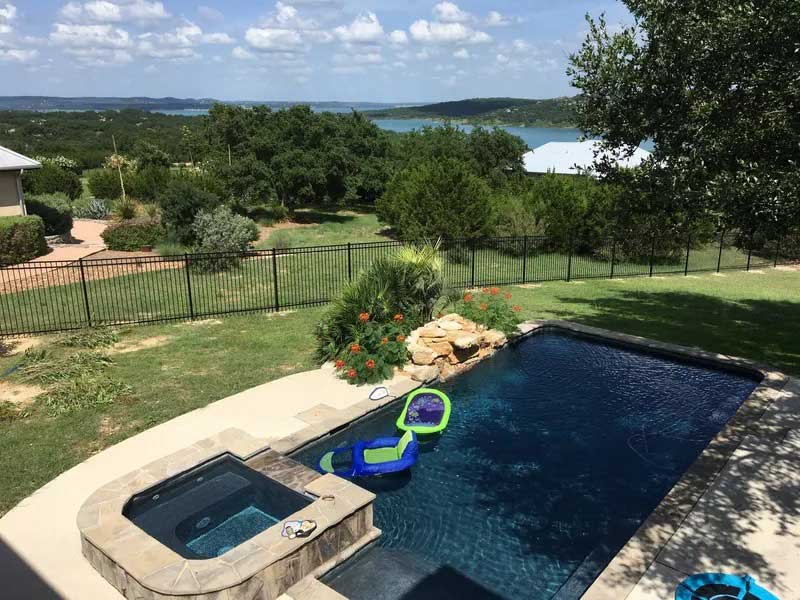
A backyard swimming pool is a welcome escape from the Texas heat, especially during long summers in New Braunfels. But whether your pool sits behind a home near Landa Park, in a growing neighborhood along Highway 46, or on a larger property in Comal County, a secure pool fence is an essential part of protecting your family and guests.
Understanding Texas pool barrier requirements, local building regulations, and common safety concerns can help you make informed decisions before installing or replacing your fence.
Quick Answer: Residential swimming pools in New Braunfels generally need a compliant safety barrier that restricts unsupervised access, particularly by young children. Texas law, applicable building codes, and local permitting requirements can affect fence height, gate operation, openings, and placement. A properly designed pool fence should help prevent unauthorized entry while meeting the requirements enforced for your specific property.
What New Braunfels Homeowners Should Know
-
Pool fence height matters. Many residential pool barrier codes require a minimum height of 48 inches, although applicable local rules and specific installations may require different dimensions.
-
Self-closing and self-latching gates are important. Gates must meet applicable safety requirements to help prevent children from entering the pool area unattended.
-
Local jurisdiction affects compliance. Properties within New Braunfels city limits may have different permitting and inspection requirements than properties in unincorporated Comal or Guadalupe County.
-
Fence materials affect long-term performance. Central Texas heat, strong sunlight, and seasonal storms can influence which fencing materials work best.
-
Existing fences are not automatically compliant. A backyard privacy fence may need modifications before it can function as an approved swimming pool barrier.
For local homeowners, pool fence safety is about more than meeting a minimum requirement. It involves creating a dependable barrier that works with the property’s layout, outdoor living space, and everyday use.
Local Data or Field Observations: Understanding Texas Pool Barrier Requirements
Texas pool fence requirements come from a combination of state law, adopted building codes, and local regulations, so homeowners should confirm which standards apply before beginning installation. Requirements can vary depending on whether the pool is residential or public, when it was built, and which authority has jurisdiction.
The Texas Health and Safety Code, including Chapter 757, establishes requirements for certain swimming pool enclosures, particularly at applicable multiunit residential properties. It should not be treated as a universal installation checklist for every private backyard pool.
For single-family residential pools, locally adopted building and residential codes are particularly important.
Common pool barrier provisions include:
-
A minimum barrier height commonly set at 48 inches.
-
Restrictions on openings that could allow a small child to pass through.
-
Gate hardware designed to close and latch automatically.
-
Restrictions on footholds and handholds that make climbing easier.
-
Special requirements when a house wall forms part of the pool enclosure.
These are general provisions, not a substitute for the exact code adopted by the local authority.
Homeowners should confirm current requirements with the City of New Braunfels Building Division or the appropriate county permitting authority before construction. This is especially important for properties outside city limits or within an extraterritorial jurisdiction.
Local Impact: Why Pool Fence Safety Matters in New Braunfels
Pool fence safety matters in New Braunfels because long swimming seasons, active outdoor lifestyles, and varied residential property layouts create ongoing opportunities for accidental pool access. A properly installed barrier helps reduce risk while supporting everyday backyard use.
The area’s warm climate allows many families to use their pools well beyond the peak summer months. Homes near Canyon Lake, established neighborhoods around downtown, and newer subdivisions toward Gruene may have different yard configurations, slopes, and fencing needs.
These local characteristics affect pool enclosure planning.
For example, a sloped backyard may require careful attention to the gap beneath the fence. A property with an existing wooden privacy fence may need a separate pool barrier or modifications to existing gates.
At Shelton’s Outback Fence Co., we understand that choosing a pool fence involves balancing safety, functionality, and the appearance of your outdoor space. The right approach begins with evaluating the property and identifying the applicable requirements before selecting a fence design.
Warning Signs: When Your Pool Fence May Not Be Safe
A pool fence may need repair, modification, or replacement when its gates, openings, structural components, or surrounding conditions allow easier access to the swimming pool. New Braunfels homeowners should regularly inspect their enclosures for visible problems.
Watch for these warning signs:
-
A gate does not close automatically. A gate that remains open creates an avoidable access risk.
-
The latch does not engage consistently. Worn or misaligned hardware can prevent secure closure.
-
There are large gaps beneath the fence. Erosion, uneven soil, or improper installation may create openings.
-
Fence posts are loose or leaning. Movement can weaken the barrier and affect gate alignment.
-
Nearby objects make climbing easier. Furniture, planters, and storage containers positioned beside a fence can undermine its protective function.
-
Panels or pickets are damaged. Broken components may create access points.
-
The fence was installed before current requirements were adopted. Older installations should be reviewed when planning modifications or major pool improvements.
If you notice any of these conditions, arrange an evaluation rather than assuming the fence remains compliant.
When to Call a Professional for Pool Fence Installation or Repairs
A professional fence evaluation is appropriate when your pool enclosure has structural damage, unreliable gate hardware, uncertain code compliance, or a layout that requires specialized planning. Homeowners can perform routine visual checks, but installation and compliance questions often require professional guidance.
Consider requesting professional assistance when:
-
Installing a new swimming pool.
-
Replacing an existing backyard fence.
-
Adding a gate or changing pool access points.
-
Addressing leaning posts or damaged panels.
-
Purchasing a property with an older pool enclosure.
-
Preparing for a required pool or fence inspection.
For properties in New Braunfels, the evaluation should also account for property boundaries, existing structures, drainage, and the requirements of the authority having jurisdiction.
A fence contractor can help assess installation options, while the local building authority determines whether the finished project satisfies applicable regulations.
Common Local Causes of Pool Fence Problems
The most common pool fence problems in Central Texas involve weather exposure, ground movement, deteriorating hardware, and installation details that do not adequately address the property. Understanding these causes helps homeowners choose more durable solutions.
1. Intense sun and prolonged heat
Summer temperatures can accelerate fading and weathering, particularly on exposed wooden fencing. Protective finishes and suitable materials can help manage long-term deterioration.
2. Soil movement and uneven ground
Central Texas properties can have rocky terrain, clay-rich soils, or sloped areas. Soil expansion, contraction, and erosion may affect post stability and fence alignment.
3. Seasonal thunderstorms
Strong winds and heavy rainfall can damage fence panels, loosen components, and wash soil away from the bottom of a fence.
4. Gate hardware wear
Frequent pool use puts repeated stress on hinges, latches, and closing mechanisms. Over time, these components may require adjustment or replacement.
5. Poor initial fence placement
A fence installed too close to climbable structures or without adequate attention to grade changes may fail to provide the intended level of protection.
Prevention and Maintenance: Keeping Your Pool Fence Safe
Regular pool fence maintenance helps homeowners identify gate problems, damaged materials, and access hazards before they become more serious. In the New Braunfels area, inspections are especially useful before swimming season and after significant storms.
Use this practical maintenance checklist:
-
Test self-closing and self-latching gates regularly.
-
Check that gates latch from their normal operating positions.
-
Inspect fence posts for movement or instability.
-
Look for broken pickets, damaged panels, and loose fasteners.
-
Check openings beneath the fence, particularly after heavy rainfall.
-
Move furniture and other climbable objects away from the enclosure.
-
Maintain finishes on wood or metal fencing as recommended.
-
Schedule repairs when damage affects the barrier’s security.
Homeowners can handle basic cleaning and visual inspections. Structural repairs, gate modifications, and questions about code compliance are better addressed by qualified professionals and the appropriate local authority.
Expected Results: What a Proper Pool Fence Should Provide
A properly designed pool fence should create a dependable physical barrier, support safe gate operation, and fit the property’s layout while satisfying applicable requirements. For homeowners, the goal is a functional enclosure that remains practical for daily use.
A well-planned installation can provide:
-
More controlled access to the swimming pool.
-
Gates that close and latch reliably.
-
A design suited to the surrounding yard.
-
Materials selected for outdoor exposure.
-
Better integration with existing fencing and landscaping.
-
A clearer path toward required inspections and approvals.
No fence can eliminate every drowning risk. Active supervision, appropriate pool safety equipment, and additional protective measures remain essential.
Common Mistakes Homeowners Make With Pool Fences
Common pool fence mistakes include assuming an existing privacy fence is sufficient, overlooking gate requirements, and selecting materials without considering the local environment. These errors can create safety concerns and potentially require costly corrections.
| Common mistake | Possible consequence | Better approach |
|---|---|---|
| Assuming any four-foot fence is compliant | Other barrier requirements may be overlooked | Verify all applicable dimensions and construction rules |
| Installing an ordinary gate latch | The gate may not meet pool barrier standards | Select compliant self-closing and self-latching hardware |
| Ignoring sloped ground | Excessive gaps may form beneath the fence | Plan installation around grade changes |
| Placing furniture beside the fence | Children may gain a climbing aid | Maintain a clear area around the enclosure |
| Skipping permit verification | Construction may require changes or additional inspections | Confirm local approval requirements before installation |
Taking time to address these details during planning can reduce problems later.
Common Local Scenario: Replacing a Backyard Fence Near a Swimming Pool
A common New Braunfels pool fence scenario involves replacing an aging wooden backyard fence that also serves as part of the swimming pool enclosure. The homeowner may want a more attractive fence without realizing that changing the existing barrier can trigger additional compliance considerations.
Imagine a home near Gruene with a backyard pool, a weathered privacy fence, and a gate that no longer closes consistently.
Replacing the damaged boards alone might improve the fence’s appearance, but it would not necessarily address the gate or other barrier requirements.
A more complete approach would involve reviewing the enclosure layout, checking current code requirements, selecting appropriate materials, and ensuring the new gate and fence work together as a protective barrier.
This is a hypothetical local example, not a description of a completed customer project.
Related Service Solutions for Pool Fencing
Pool fence installation, gate upgrades, and targeted fence repairs can address many of the access and structural concerns homeowners encounter around residential swimming pools. The appropriate solution depends on the existing barrier, property layout, and applicable code.
Potential options include:
New pool fence installation
A dedicated pool enclosure can establish a defined barrier around the swimming area. Placement, height, openings, and gate design should all be considered.
Fence replacement
Replacing deteriorated fencing may be appropriate when structural problems affect several sections or when the existing design is unsuitable.
Pool gate improvements
Correctly specified gate hardware can help address unreliable closing and latching.
Fence material selection
Aluminum, steel, and appropriately designed wood fencing may be considered, depending on the property’s needs and applicable requirements. Material choice alone does not establish code compliance.
We can help homeowners discuss fencing options with safety, usability, and property conditions in mind.
Comparing Your Pool Fence Options
The best pool fence option depends on the level of protection required, the condition of the existing fence, maintenance preferences, and the design of the property. New Braunfels homeowners should compare both the initial installation and long-term upkeep.
| Option | Potential advantages | Key considerations |
|---|---|---|
| Aluminum fencing | Low maintenance and open visibility | Must meet applicable spacing and gate requirements |
| Steel fencing | Strong construction and multiple design options | Protective coatings and corrosion resistance matter |
| Wood fencing | Privacy and traditional appearance | Requires maintenance and careful barrier design |
| Existing fence modifications | May preserve usable fence sections | Only suitable if the entire barrier can meet requirements |
| Complete fence replacement | Opportunity to correct layout and structural issues | Typically involves greater project scope |
For an older enclosure with widespread damage, replacement may be more practical than repeated repairs. For an otherwise sound fence, targeted improvements may be sufficient.
Service Areas: Pool Fencing in New Braunfels and Surrounding Communities
Pool fence planning in New Braunfels and surrounding Central Texas communities should reflect the property’s location, terrain, and governing building requirements. Homeowners in Comal County, Guadalupe County, Gruene, and areas toward Canyon Lake may encounter different permitting considerations.
Before beginning a project, verify the responsible jurisdiction and applicable requirements for the specific address.
Cost of Ignoring Pool Fence Problems
Delaying necessary pool fence repairs can leave unsafe access points in place and allow relatively minor damage to develop into larger structural problems. The consequences may include additional repair expenses, inspection complications, and increased safety risks.
For example, a gate that fails to latch may become less reliable as its hinges wear. A loose fence post can eventually affect adjoining panels.
Addressing these issues promptly helps preserve the barrier’s function and may reduce the extent of future repairs.
FAQ: Pool Fence Safety and Code Compliance in New Braunfels
1. Is a fence required around a residential swimming pool in New Braunfels?
Residential swimming pools in New Braunfels are generally subject to applicable pool barrier requirements. The exact rules depend on the adopted codes, pool configuration, and property jurisdiction. Homeowners should verify current requirements with the City of New Braunfels Building Division before installing or modifying an enclosure.
2. How tall does a pool fence need to be in Texas?
Many residential pool barrier standards require a minimum fence height of 48 inches, but this is not a universal requirement for every Texas property. Other applicable rules may establish different measurements or conditions. Always verify the governing code before selecting fence dimensions.
3. Do pool gates need to be self-closing and self-latching?
Pool access gates generally must meet applicable self-closing and self-latching requirements. The rules may also specify gate swing direction, latch placement, and other details. Homeowners should confirm these provisions with the relevant building authority rather than assuming that a standard backyard gate is sufficient.
4. Can my existing privacy fence serve as a pool barrier?
An existing privacy fence may serve as part of a pool enclosure if it satisfies all applicable barrier requirements. Height alone is not enough. Gate hardware, openings, climbability, structural condition, and placement must also be considered. An evaluation can help determine whether modifications are necessary.
5. Do I need a permit to install a pool fence in New Braunfels?
Permit requirements depend on the project’s scope, location, and applicable city regulations. A fence associated with a new swimming pool may be reviewed differently from an ordinary fence replacement. Confirm the current permitting and inspection process with the City of New Braunfels before construction begins.
6. Are pool fence rules different in Comal County and Guadalupe County?
Pool fence requirements can differ depending on whether a property is within city limits, in an extraterritorial jurisdiction, or in an unincorporated county area. State requirements may also apply. Property owners should identify the authority having jurisdiction and confirm its adopted codes before proceeding.
7. What type of pool fence works best in Central Texas weather?
Aluminum and properly protected steel are common choices for homeowners seeking durable, relatively low-maintenance pool fencing. Wood can provide privacy but generally requires more upkeep. The best material depends on sun exposure, drainage, desired appearance, and whether the finished design meets pool barrier requirements.
8. How often should homeowners inspect their pool fences?
Homeowners should inspect pool fences regularly, with particular attention to gate operation and visible damage. Additional checks before heavy swimming use and after major storms are sensible in Central Texas. Any condition that compromises the enclosure’s protective function should be addressed promptly.
9. Can a pool fence make my backyard completely safe?
No pool fence can guarantee complete safety. A compliant barrier is one important layer of protection, but responsible adult supervision, appropriate pool safety equipment, and additional safeguards remain necessary. Homeowners should view fencing as part of a broader approach to preventing unauthorized pool access and drowning incidents.
Protect Your Pool Area With the Right Fence
Pool fence safety begins with understanding the requirements that apply to your property and choosing an enclosure designed for dependable everyday use.
For homeowners in New Braunfels and surrounding communities, factors such as terrain, weather exposure, gate placement, and local regulations all deserve attention.
At Shelton’s Outback Fence Co., we believe informed planning is the foundation of a better fencing project. Our goal is to help you explore practical options for protecting your outdoor space.
Make Your New Braunfels Pool Area Safer and More Secure
A thoughtfully planned pool fence can improve access control, complement your backyard, and help you work toward applicable safety requirements.